Bengaluru Real Estate Growth (1980–2025)
For more than four decades, Bengaluru has evolved from a serene, garden-filled city into India’s most dynamic real estate and technology hub. Every decade brought its own wave of change — new industries, new infrastructure, and new opportunities.
Let’s explore Bengaluru’s fascinating real estate growth journey year-by-year — from 1980 to 2025.
🌿 1980–1985: The Calm Before the Boom
1980–1985 marked a period of peace, greenery, and low-density housing. Bengaluru was known as the “Garden City” — quiet roads, bungalows, and government quarters dominated the landscape.
- Real estate activity was limited to BDA plot allotments.
- Key areas: Jayanagar, Malleswaram, Rajajinagar, Indiranagar.
- Property values were steady — ₹50–100 per sq. ft in prime zones.
- Government employees, PSUs (HAL, BEL, ITI) drove housing demand.
- Developers were rare — construction was mostly owner-built homes.
Real estate wasn’t an “investment” yet — it was about owning a home in a peaceful city.
💼 1986–1990: The First Signs of Modernization
By the late 1980s, Bengaluru began to urbanize.
- The Bangalore Development Authority (BDA) created planned layouts in Banashankari, HSR, and Vijayanagar.
- Electronics City (established in 1978) began attracting small IT units.
- Rental demand increased with more private jobs entering the market.
- Roads were widened, and private buses increased mobility.
This period laid the groundwork for Bengaluru’s IT transformation — the foundation decade of the modern city.
💻 1991–1995: Liberalization Sparks Growth
1991 changed everything — India opened its economy.
- Infosys, Wipro, and Texas Instruments expanded their operations.
- Bengaluru became India’s first IT capital.
- Office spaces emerged in Koramangala, Indiranagar, and Domlur.
- Residential demand from young professionals began to rise.
- Property rates doubled in 4 years due to migration and IT employment.
By 1995, Whitefield and Electronic City became hot spots for land acquisition by developers.
🚀 1996–2000: The First Real Estate Boom
This period saw the first major real estate boom in Bengaluru.
- The IT industry exploded, creating huge housing demand.
- Prestige, Brigade, and Sobha launched their early landmark projects.
- Outer Ring Road (ORR) development began — connecting key suburbs.
- Whitefield transformed from farmland to tech corridor.
- Residential apartments emerged in Koramangala, Indiranagar, HSR Layout.
Average land prices:
- Whitefield: ₹150–300/sq. ft
- Koramangala: ₹800–1000/sq. ft
- Central areas: ₹1500–2000/sq. ft
By 2000, Bengaluru had transformed into a modern metropolitan with a rising skyline.
🌆 2001–2005: Infrastructure & Globalization
Bengaluru became a global outsourcing hub.
- MNCs like IBM, Accenture, and Intel opened offices.
- The IT corridor (ORR–Sarjapur–Whitefield) took shape.
- Housing demand rose from both end-users and investors.
- Electronic City Phase II expanded rapidly.
- Early luxury projects appeared in CBD and Indiranagar.
Infrastructure milestones:
- Flyovers constructed at Airport Road & Richmond Circle.
- Planning for Bangalore International Airport began (Devanahalli).
- Rapid migration from across India boosted rentals and appreciation.
🏗️ 2006–2010: The Real Estate Explosion
The mid-2000s was Bengaluru’s fastest growth phase.
- Tech parks: Manyata, Bagmane, RMZ Ecospace, and Embassy Tech Village launched.
- Builders: Prestige, Brigade, Sobha, Puravankara, Mantri led the luxury segment.
- New areas emerged: Sarjapur Road, Bellandur, Marathahalli.
- Airport construction at Devanahalli fueled North Bengaluru development.
- Residential apartment living became the new norm.
Price Growth (2005–2010):
- Whitefield: ₹1,000 → ₹3,000/sq. ft
- Koramangala: ₹2,500 → ₹6,000/sq. ft
- Hebbal: ₹1,200 → ₹3,500/sq. ft
2008: Kempegowda International Airport inaugurated — redefining Bengaluru’s geography.
🚆 2011–2015: Metro & Modern Bengaluru
This was the decade of urban infrastructure transformation.
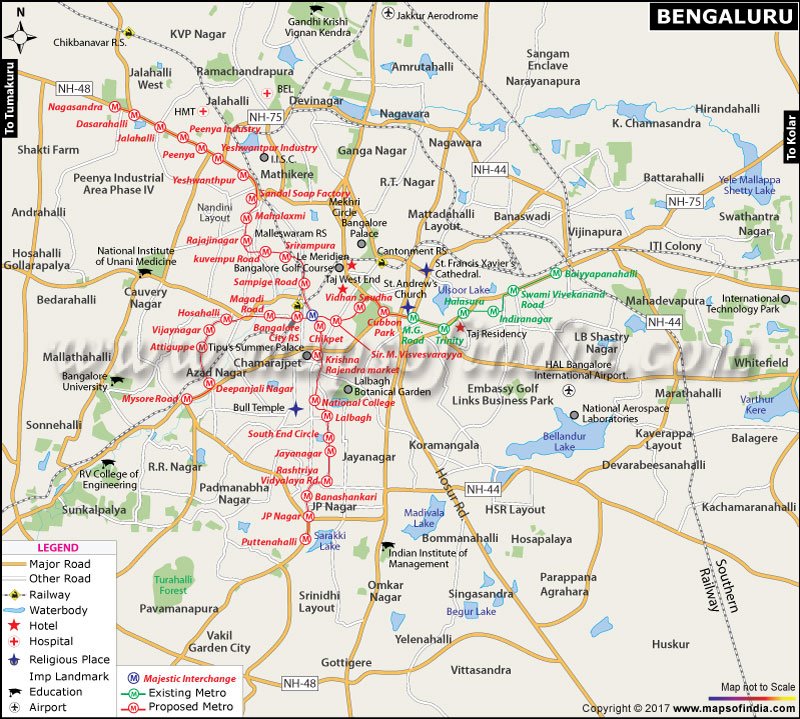
- Namma Metro opened in 2011 — improved connectivity across the city.
- Hebbal, Thanisandra, Yelahanka gained value due to proximity to the airport.
- Devanahalli became the new growth corridor.
- East Bengaluru (Whitefield, KR Puram) expanded further with tech parks.
Real Estate Highlights:
- Growth of mixed-use developments (Prestige Shantiniketan, Brigade Gateway).
- Demand for luxury housing increased.
- Rental yields stabilized due to balanced demand.
2014–15: Land rates crossed ₹_______/sq. ft in prime zones like MG Road and Lavelle Road.
🌇 2016–2019: Regulation, Transparency & Premium Living
This was the regulation and consolidation era.
- RERA (2016) enforced developer accountability.
- GST (2017) simplified taxation.
- Digital land records improved buyer confidence.
Market Trends:
- Developers focused on quality, amenities, and sustainability.
- High-rise apartments and gated communities became standard.
- Whitefield, Hebbal, Thanisandra, and Kanakapura Road dominated launches.
Luxury projects like UB City Residences, Prestige Kingfisher Towers, and Sobha Indraprastha redefined Bengaluru’s skyline.
🏡 2020–2022: Pandemic & Property Resilience
COVID-19 slowed the economy, but Bengaluru’s real estate stood strong.
- Homebuyers shifted focus to spacious homes and plotted developments.
- Work-from-home increased suburban property demand (Sarjapur, Devanahalli, Budigere).
- Developers introduced smart home automation and flexible designs.
Property prices remained stable, recovering faster than most Indian metros by 2022.
Bengaluru proved its resilience and investor confidence.
🌱 2023–2025: Smart, Sustainable & Global
Bengaluru (2023–2025) is entering its most futuristic phase.
Key Growth Drivers:
- Peripheral Ring Road (PRR) & Satellite Town Ring Road (STRR) improving outer connectivity.
- Metro Phase connecting Whitefield to Kengeri and Electronic City.
- North Bengaluru emerging as the next investment capital.
- Green & Smart Homes: Solar panels, EV charging, and digital controls becoming common.
- Luxury Townships: Prestige, Godrej, Brigade, Adarsh, and Embassy expanding footprint.
Average property price growth (2020–2025):
- North Bengaluru: 35–40%
- East Bengaluru: 25–30%
- Central Bengaluru: 15–20% (stabilized due to saturation)
Bengaluru remains India’s #1 city for real estate investment, supported by employment growth, urban planning, and sustainable development.
🏙️ Summary Table: Bengaluru Real Estate Evolution (1980–2025)
| Year Range | Key Events | Real Estate Impact |
|---|---|---|
| 1980–1985 | Garden City era | Low-density housing, steady prices |
| 1986–1990 | Industrial & PSU expansion | Planned layouts, early urbanization |
| 1991–1995 | Economic reforms | IT revolution begins |
| 1996–2000 | IT boom | Whitefield, E-City rise |
| 2001–2005 | Airport & ORR expansion | MNC entry, housing surge |
| 2006–2010 | Globalization peak | Tech parks, luxury apartments |
| 2011–2015 | Metro development | Urban lifestyle evolution |
| 2016–2019 | RERA & GST | Transparency, buyer trust |
| 2020–2022 | Pandemic & WFH | Suburban growth, plotted projects |
| 2023–2025 | Smart city era | Sustainable, tech-driven real estate |
📈 40 Years of Price Appreciation
| Year | Avg. Price per sq. ft (City Avg.) | Growth |
|---|---|---|
| 1985 | ₹100–150 | – |
| 1995 | ₹400–600 | 300% |
| 2005 | ₹2,000–3,000 | 400% |
| 2015 | ₹6,000–8,000 | 250% |
| 2025 | ₹10,000–14,000 (Prime), ₹5,000+ (Suburban) | 75–100% |
🌍 Bengaluru’s Global Future (Beyond 2025)
- India’s #1 real estate investment market (Knight Frank, 2024).
- Projected to become a $150 billion real estate economy by 2040.
- Urban expansion toward Bidadi, Nelamangala, and Hoskote.
- Focus on green building certifications and carbon-neutral communities.
The next decade (2025–2035) will see AI-driven property management, smart metros, and fully digital home transactions.
🏡 Conclusion: The City That Never Stops Growing
From ₹100 per sq. ft in 1985 to ₹60,000+ per sq. ft in 2025, Bengaluru’s real estate story is a tale of transformation, innovation, and resilience.
Every decade has contributed to the city’s evolution — from PSUs to IT to Smart Tech.
No other Indian city combines employment, infrastructure, livability, and investment potential as strongly as Bengaluru.
At Veeresh Realty, we celebrate this four-decade journey — connecting people with the best homes, investments, and opportunities in India’s most dynamic real estate market.